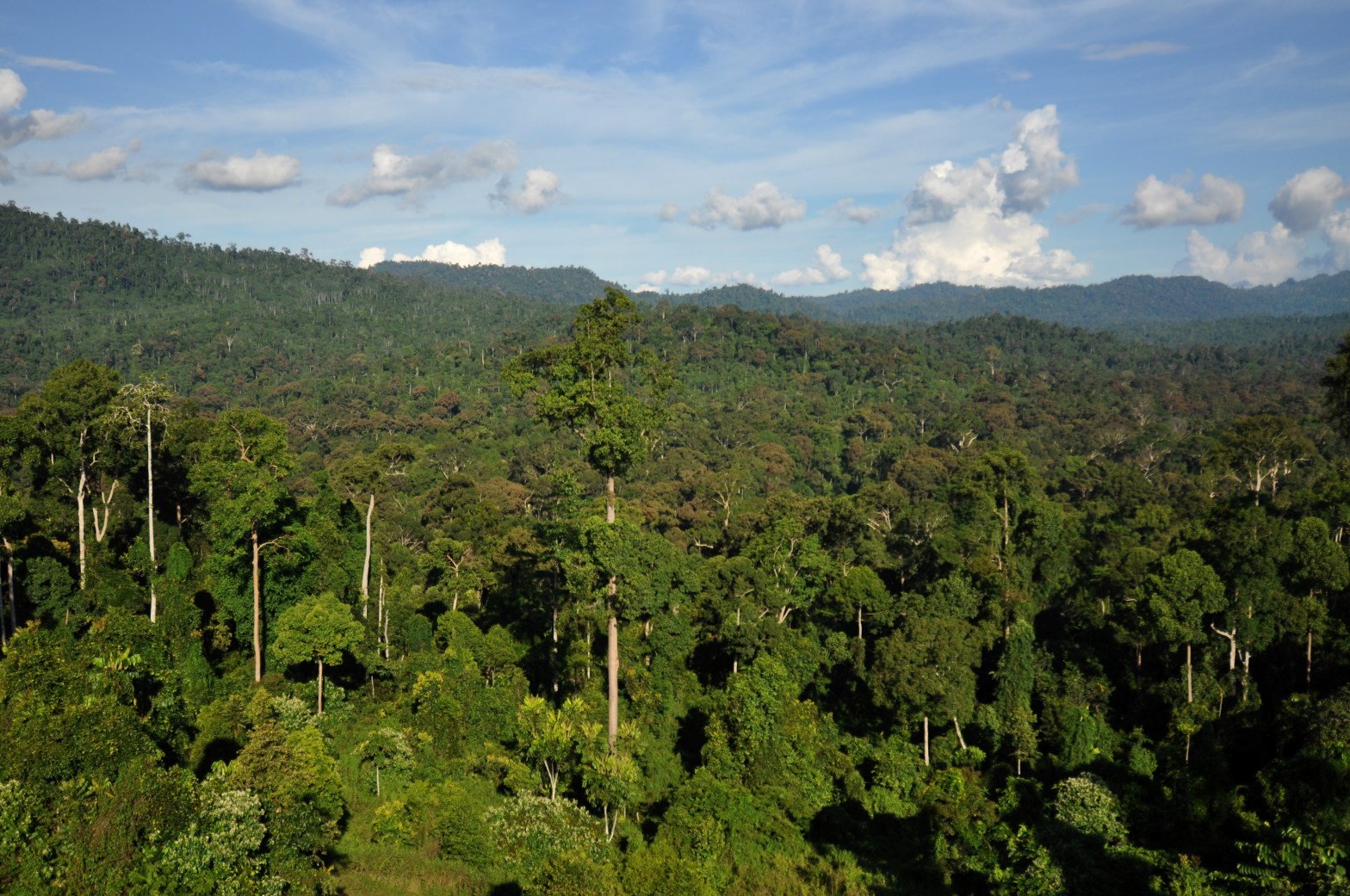
In the early 1990s, the Philippines – a country known to be one of the greatest victims of deforestation – experienced a sudden slight increase in forest cover. While indeed there have been massive efforts of reforestation in the archipelago, that increase is mainly due to a change in definition of what a forest is. According to the Philippine government’s Forest Management Bureau (FMB) of the Department of Environment and Natural Resources (DENR), a forest is any tree-covered land of an average tree-height of more than 0.5 hectares. This is in accordance with the definition given by the Food and Agriculture Organization (FAO) of the United Nations.
While this definition indeed allows us to protect any tree-covered land to a certain degree, it skews the view on what a forest really is. That could potentially lead to loopholes in restoration, where a mining company after conducting an operation could simply plant trees and claim they have properly reforested the area.
Thus, it is appropriate to discuss what really makes a forest. Here, as we discuss the criteria of a fully functioning forest, we will see that it is much, much more complex that a simple plantation of trees.
Plants and Trees are Just One Part
Edited from: https://en.wikipedia.org/wiki/Stratification_(vegetation)#/media/File:Stockwerke_wald.png
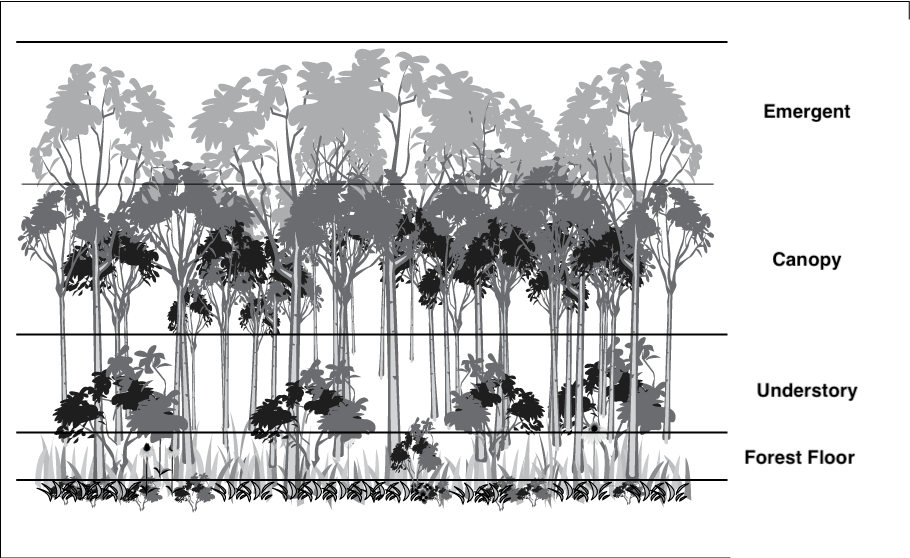
Any forest should indeed have these. Moreover, their presence allows the biome to be divided into four layers: forest floor, understory, canopy, and emergent layer. The forest floor, being the darkest layer, houses homes for insects and other critters. Moss also thrives here among the rocks, providing a large bulk of the oxygen in the entire biome. Much of the nutrients stored in plants are quickly recycled via decay, which are facilitated by detritivores such as fungi and soil bacteria. The nutrients eventually find their way back into the plants. But this section of the biome can already reach a height of 5m. So we can see that the minimum requirement of a forest given by FAO and FMB-DENR is inadequate.
Going a little higher, we reach the understory, which receives little sunshine. Thus, plants here have adapted by evolving broad leaves that have a greater chance of being hit by sunlight for photosynthesis. In tropical rainforests, animals that live here include jaguars, tree frogs, and leopards.
Climbing even higher, the canopy is what we usually see when viewing an expanse of forest. This portion of the forest is usually the most diverse. It can provide a habitat for a vast variety of birds, monkeys, snakes, among others. This is because it is abundant in food, especially when the trees include fruiting trees. Much of the trees here receive the a large portion of sunlight hitting the forest cover.
Lastly, the emergent layer – which can grow indefinitely taller than the canopy – belongs to the tallest of trees that overlook the canopy of the forest. The emergent layer is easily seen as the aggregate of trees that poke out of the canopy, like patrol towers jutting from the ground. The same animals from the canopy can be found here. Many birds of prey such as the Philippine eagle prefer to nest in the emergent layer.
Water Regulation
Water, being crucial in the reactions in photosynthesis, is absorbed by all kinds of plants from the soil. Minerals that are dissolved in it are also taken up by the roots of the plant, thus filtering it. Sources of this liquid include river systems and rain, which also makes the area more humid.
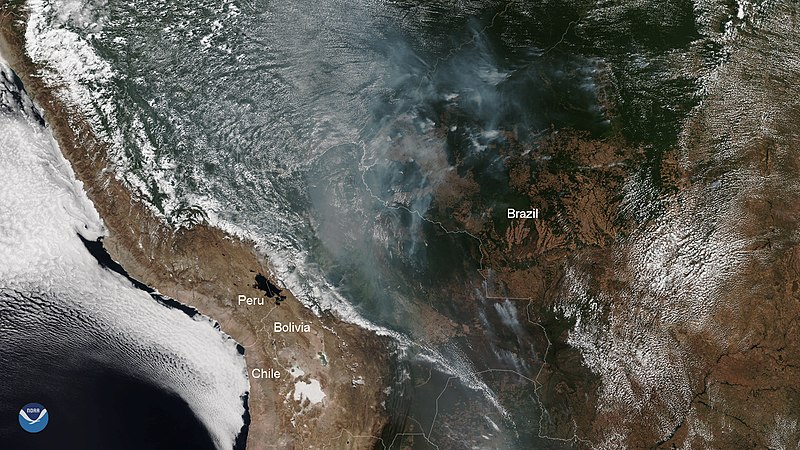
But a large portion of the absorbed water is not used, and manages to escape through the stomata, which are leaf pores that are also responsible for the entry of carbon dioxide for photosynthesis. This process is called transpiration. Thus, the trees themselves also help in making the climate even more humid. This is especially true in tropical rainforests such as the Amazon, where the humidity is so intense that it’s able to form a river of water vapor in the sky in the form large groups dense clouds that travel with the wind.
A denser canopy would also mean less heat and light reaching the forest floor. This leads to better water trapping in both the soil and in the air below the canopy. It would also lead to less transpiration from the trees as the heat stimulates the water to escape, thus allowing the trees to store more of the liquid.
The forest’s water does not only affect the dynamics of the biome itself, but also the surrounding areas. In the previously mentioned Amazon sky river, the water travels through out South America and aides in distributing rainfall throughout the continent. That’s why despite the vastness of the landmass, the only desert lies on a thin section on the Western side of the Andes, opposite the side of the Amazon Basin.
Source: https://commons.wikimedia.org/wiki/File:20190812-amazon.jpg
Because of this, the Pantanal – the world’s largest tropical wetland on the southwestern edge of Brazil – formed. The wetland also provides a vast array of species such as capybaras, jaguars, and marsh deers.
Biodiversity
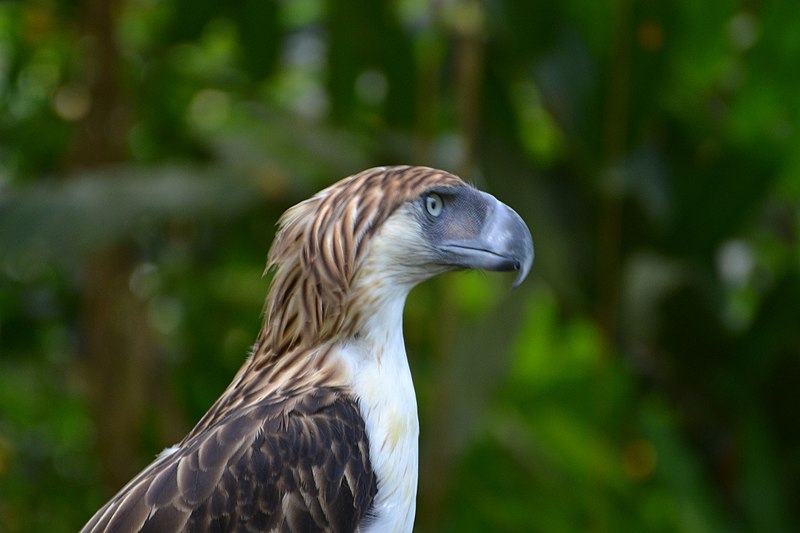
Finally, a forest would need to have a relatively higher biodiversity than its surrounding area. This is true for all types of forest, ranging from tropical to boreal. This is because the shelter of the trees creates more habitats and homes for animals and fungi, which then leads to more interaction between them. This interaction triggers evolutionary mechanisms such as mutation and natural selection, thus leading to greater diversity.
However, these mechanisms are more obvious in tropical rainforests. Despite covering only 6% of Earth’s total landmass, they house around 80% of the documented species in the entire world. This intense biodiversity have led to some calling it megadiversity.
Due to deforestation, the menagerie of plants and animals is in danger. Every year, 140,000 sq km of rainforests are destroyed, providing less homes for said species. Even if we continue to reforest areas that have been cleared of trees, it would be difficult to return to its original state of biodiversity. Thus, the better choice is to continue conservation.
And conservation does not necessarily entail the halting of economic activity. In fact, conserving these forests creates a positive impact on economic sustainability. Retaining the biodiversity of these biomes provides a bountiful amount of resources that contribute to medicine, food, rubber, gum, among others. Biodiversity allows a steady chain of supply for these industries that need these resources, as long as the extraction is sustainable and does not disrupt the balance of the ecosystem.
If that balance is disrupted, it would lead to a chain of events that would eventually lead to a loss of species and the forest’s collapse. And if the forests collapse, those vital resources would disappear forever – any plantation of a group of trees won’t mimic the vitality of the original ecosystem.
References
Aron P, Poulsen CJ, Fiorella RP, Matheny AM. 2019. Stable Water Isotopes Reveal Effects of Intermediate Disturbance and Canopy Structure on Forest Water Cycling. JGR Biogeosciences 124(10): 2958-2975.
Senate of the Philippines [Internet]. c2015. Quezon City, NCR: Senate of the Philippines 18th Congress; [cited 2020 June 28]. Available from: https://www.senate.gov.ph/publications/SEPO/AAG%20on%20Philippine%20Forest_Final.pdf
Space Radiation Lab [Internet]. c2019. Pasadena, CA: California Institute of Technology; [cited 2020 June 28]. Available from: http://www.srl.caltech.edu/personnel/krubal/rainforest/Edit560s6/www/whlayers.html
WWF [Internet]. c2020. Gland, VD: World Wildlife Fund; [cited 2020 June 28]. Available from: https://wwf.panda.org/our_work/forests/importance_forests/tropical_rainforest/
 Figure 73
#/media/File:Stockwerke_wald.png)
